

16 July . 2026
How Orting School District Plans for a Growing Community
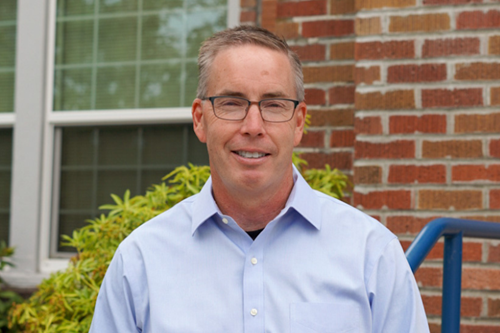
On one of the last full days of school, while students were out celebrating Field Day, Ed Hatzenbeler, superintendent of Orting School District, was ready to talk about all things Orting, OSD, and the role of community in places like Tehaleh.
Orting is tucked into the eastern side of Pierce County, framed by farmland, foothills, neighborhoods, trails, and a strong sense of place. But as Hatzenbeler explained, the school district’s identity extends well beyond the City of Orting itself. OSD is shaped by a 45 square mile geography that serves families across a range of communities, including Orting, Puyallup, Bonney Lake, Graham, and unincorporated areas.
That geography matters. In some areas, the district is rural. In others, it sits closer to growing neighborhoods, new development, and expanding services. For Tehaleh families, that means becoming part of a larger school district story.
Laying Plans for the Next Generation
For a school district, growth shows in practical ways long before a new student walks through the door. A new neighborhood can mean changes to classroom capacity, staffing, transportation, school boundaries, facilities, and long-term financial planning.
Transportation is an example. When asked how much of his role involves bus schedules and routing, Hatzenbeler laughed.
“Nobody would get picked up if it were me,” he said.
Fortunately, he added; the district has transportation staff and routing systems that help the team anticipate what is coming. When new homes are planned, the district can begin looking at where students may live, how many students may be coming, and what routes might be needed.
“With our routing system software, they can draw boundaries over neighborhoods,” Hatzenbeler said. “If we know there’s 500 more houses, we can be thinking about that route this spring for what needs to happen in the fall, to make sure that we have buses and staffing ready to go to pick kids up.”
That kind of planning may not be visible to families every day, but it is essential. A growing district must be ready for the right number of students in the right places at the right time. It must think about buses before they are needed, classrooms before they are full, and facilities before overcrowding becomes a crisis.
In other words, growth planning is not simply a matter of building as fast as possible. It is about forecasting carefully, listening locally, working with developers and municipalities, and making decisions that can hold up over time.
“The biggest point for us, honestly, is talking to the developers and the people that are building and developing,” Hatzenbeler said. “That’s your best source of information. Working with your municipalities to figure out what’s coming, and when, and how do you get out in front of that.”
What a Superintendent Does Best
One thing Hatzenbeler wants families to understand is that smaller districts are not simpler.
“The small is every bit as involved as the big,” he said. “And to a lot of degree, the small doesn’t have the team and the breadth of staffing.”
In a larger district, responsibilities may be spread across many departments. In a smaller district like OSD, leaders often carry multiple roles and remain closer to the day-to-day work of schools.
“We don’t have a gal for that,” Hatzenbeler said. “I’m probably the gal and the guy for that.”
It was a lighthearted moment, but it pointed to something real. Smaller districts often rely on accessibility, relationships, and trust. There may be fewer layers between a question and the person who can help answer it, which can be especially meaningful for families trying to understand how schools, facilities, bonds, and growth planning all connect.
For families in Tehaleh and throughout the district, access can matter. Growth brings questions. Families want to know where their children will go to school, how bonds and facilities work, what opportunities students will have, and how the district is preparing for change.
Hatzenbeler said that trust has to be earned carefully.
“Whatever you promise, you sure as heck want to be able to deliver,” he said. “Or you’re creating a lot of mistrust in what you do.”
That is especially true when it comes to funding. School construction, renovations, expansions, and major facilities improvements often require years of planning and voter-approved funding. The district’s recent bond approval is part of that long-range growth conversation, but Hatzenbeler said the district is already thinking about what comes next.
In a growing community, work is never only about solving today’s needs. It is also about anticipating the next set of questions and making sure the district is prepared to answer them.

You Can’t Replace Human Connection
Like districts across the country, Orting is also thinking about technology, artificial intelligence, student learning, and the role of human connection in an increasingly digital world.
Hatzenbeler describes new technology through the image of a pendulum. Email, cell phones, apps, classroom devices, and now AI all tend to arrive with excitement and urgency. Then, after a period of widespread adoption, concerns emerge. Communities begin by asking what has been gained, what has been lost, and where the balance should be.
“With any new technology, whether it’s email or when cell phones came out or whatnot, you push a pendulum,” he said. “And then somewhere in the push and the pull, we re-norm.”
He sees AI as another version of that swing. There are things it may do very well. It may help students receive faster feedback, help teachers identify where a child is stuck, and support more personalized learning. In some settings, technology can make lessons more engaging, interactive, and responsive than anything previous generations experienced.
“There are certain things AI is going to do better,” Hatzenbeler said. “It’s going to give students and staff better feedback, more timely feedback about what’s working, what’s not working.”
But he is cautious about treating technology as a fix-all solution. Students still need to collaborate, talk face to face, work through differences, and learn from adults who know them. Technology may support learning, but it cannot replace the relationships that help students feel seen, understood, and capable.
“What we learned during COVID is that you can’t replace human connection and collaboration,” he said. “If you try, you will create more harm.”
For Hatzenbeler, the question is not whether AI will be part of education. It is how schools will use it wisely.
“How do we use that as a tool and a support, and not as a replacement?” he asked.
Still, the center remains the same.
“You don’t lose human-to-human connection,” he said.
Beyond Graduation
For students, that future is already taking shape.
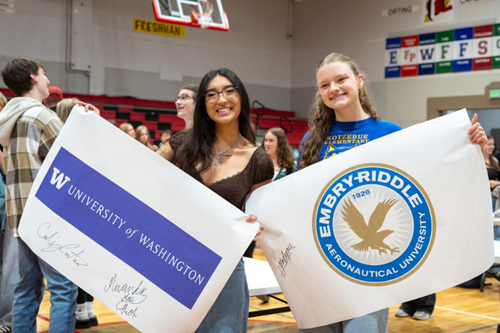
Graduation offered one clear picture of the district’s priorities. Orting graduates are not being pointed toward one single definition of success. Instead, the district is working to support a range of pathways: military service, four-year colleges, local higher education options, trades, apprenticeships, athletics, clubs, and career training.
“We don’t try to put limits or gates on where our graduates aspire to go or what their dreams are for themselves,” Hatzenbeler said.
He described posters and banners representing the many different pathways students are choosing. Some students are heading to four-year universities, including highly selective schools. Others are staying closer to home for affordability and access. Some are entering trades or apprenticeships. Others are serving in the military.
“Whatever their pathway is, our job is to try to help open them up to think about that dream and exploration,” he said. “And support them as best as we can.”
That commitment extends to Career Technical Education, athletics, clubs, and other opportunities that help students find where they belong. Hatzenbeler noted that Orting students have represented the district at state and national levels, and that the district hopes to expand opportunities in the years ahead.
One possibility includes partnering with Clover Park Technical College to bring adult education courses closer to home, so residents do not have to travel as far for certain certifications or programs.
For Tehaleh, that means the relationship with the Orting School District will continue to grow as the community grows. New homes bring new students. New students bring new needs. New needs bring new conversations about facilities, transportation, programs, and the future.
Getting to Know Orting Schools
For the Orting School District, the work ahead is both practical and personal. It involves facilities and funding, buses and boundaries, programs, and partnerships. But it also involves belonging. It involves making sure students are known, families are heard, and communities feel connected to the schools that serve them.
To learn more about Orting School District, visit the district’s website or contact the district office. Families with school-specific questions are encouraged to reach out directly to their school, where staff and administrators can help point them in the right direction.